Looking at Ripple Prime's $200m Credit Facility
Ripple's prime brokerage arm secured new financing from Neuberger Berman, giving it more capacity to extend margin to investors trading across traditional and digital markets.
What does this facility let institutions do with XRP and RLUSD inside a regulated prime brokerage?
The real story is balance-sheet capacity. Prime brokerages run on financing, margin, collateral, lending, and settlement, and capacity caps how much of each they can do. More capacity means more room for clients to grow.
This unlocks XRP and RLUSD to start working as collateral. The kind institutions pledge, borrow against, margin with, and route through a trading stack every day.
When an asset becomes collateral, it changes its profile so it can get posted, moved, marked to market, called when prices move, settled when trades close. That’s the kind of usage that builds the network and compounds growth.
If a hedge fund is running positions across crypto, FX, fixed income, and equities, XRP or RLUSD can sit inside that collateral stack and support financing on one desk and margin on another, and it does it across markets.
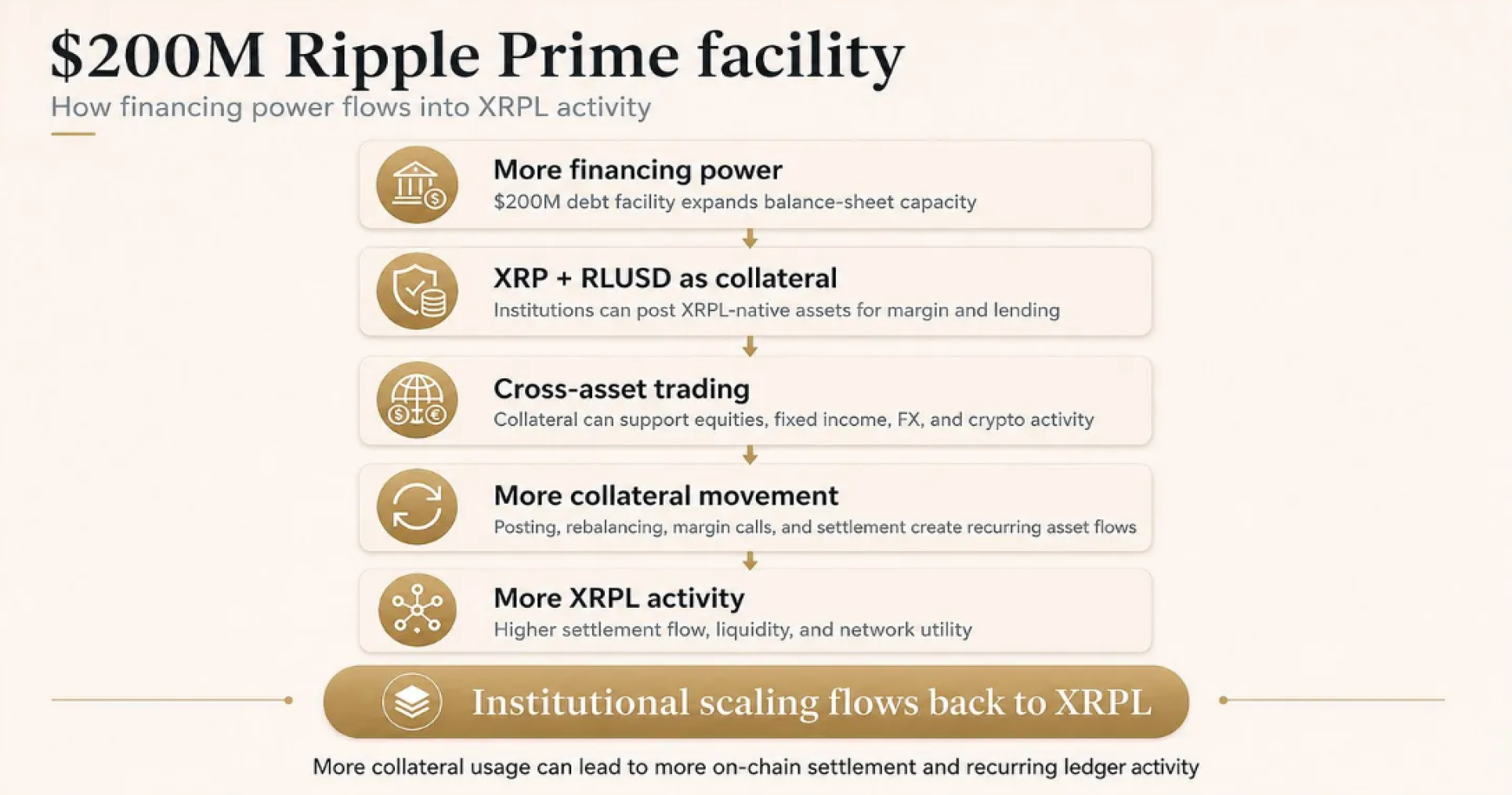
A debt facility gives Ripple Prime more power to finance clients, and the follow-on effect is huge. When those clients use XRP and RLUSD as collateral, the activity flows back through XRPL.
Every collateral movement creates a potential on-chain touchpoint. Posting collateral, moving RLUSD, rebalancing margin, settling post-trade flows, handling liquidations. All of it adds up.
This is what institutional plumbing actually looks like and keeps a network relevant.
Ripple Prime also gives XRPL a TradFi bridge that makes sense. Prime brokerage clients already think in collateral, margin, financing, custody, execution, settlement. The XRPL gets to slot into a workflow they already run rather than asking anyone to learn new behavior.
Institutions adopt rails that cut cost, speed up settlement, or fit an approved operating model.
If Ripple Prime moves more post-trade activity onto those rails, ledger activity rises with client volume. Trades, collateral movement, settlement, and liquidity tend to stay where they’re being used.
Institutions need stable collateral and settlement cash, and RLUSD can sit next to XRP in the same stack. XRP for bridge liquidity, RLUSD for dollar settlement and margin collateral. They cover different jobs inside one regulated structure.
Prime brokerage is multi-asset by design. A single client might be running BTC options, FX, Treasuries, equities, and crypto in the same week. The margin system needs collateral it can rely on across all of it. Once XRP and RLUSD qualify, they get pulled into more workflows.
Neuberger Berman’s working relationship here lands with compliance teams, risk committees, allocators, and trading desks who need proof the stack can handle serious flow.
Institutional comfort grows in stages. The rail gets tested, it picks up narrow functions, and gets added to more systems. Volume follows the path of least friction once the path is approved internally. That’s where the flywheel starts moving.
Ripple Prime already runs the right kind of business for this. Collateral-heavy and settlement-heavy, with client flow concentrated in workflows the XRPL can serve. As that business scales, the XRP Ledger doesn’t need every trade on-chain. It just needs more of the back-end activity to touch the ledger.
The $200M buys more financing without selling equity. Financing supports more client trading. Client trading generates more collateral movement. Collateral movement runs through the XRPL. The chain shows up in the middle of every workflow, which is exactly where you want it.
Prime brokerage growth builds through repeat client activity, week after week regardless of public sentiment.
Institutions have a reason to use XRP and RLUSD because those assets help them move collateral, margin, liquidity, and settlement inside a regulated financial stack.
The headline here is really that Ripple Prime is scaling an institutional on-ramp into the XRPL. Higher collateral demand, more settlement flow, more RLUSD circulation, and more reason for liquidity to live on-chain.